
 admin
admin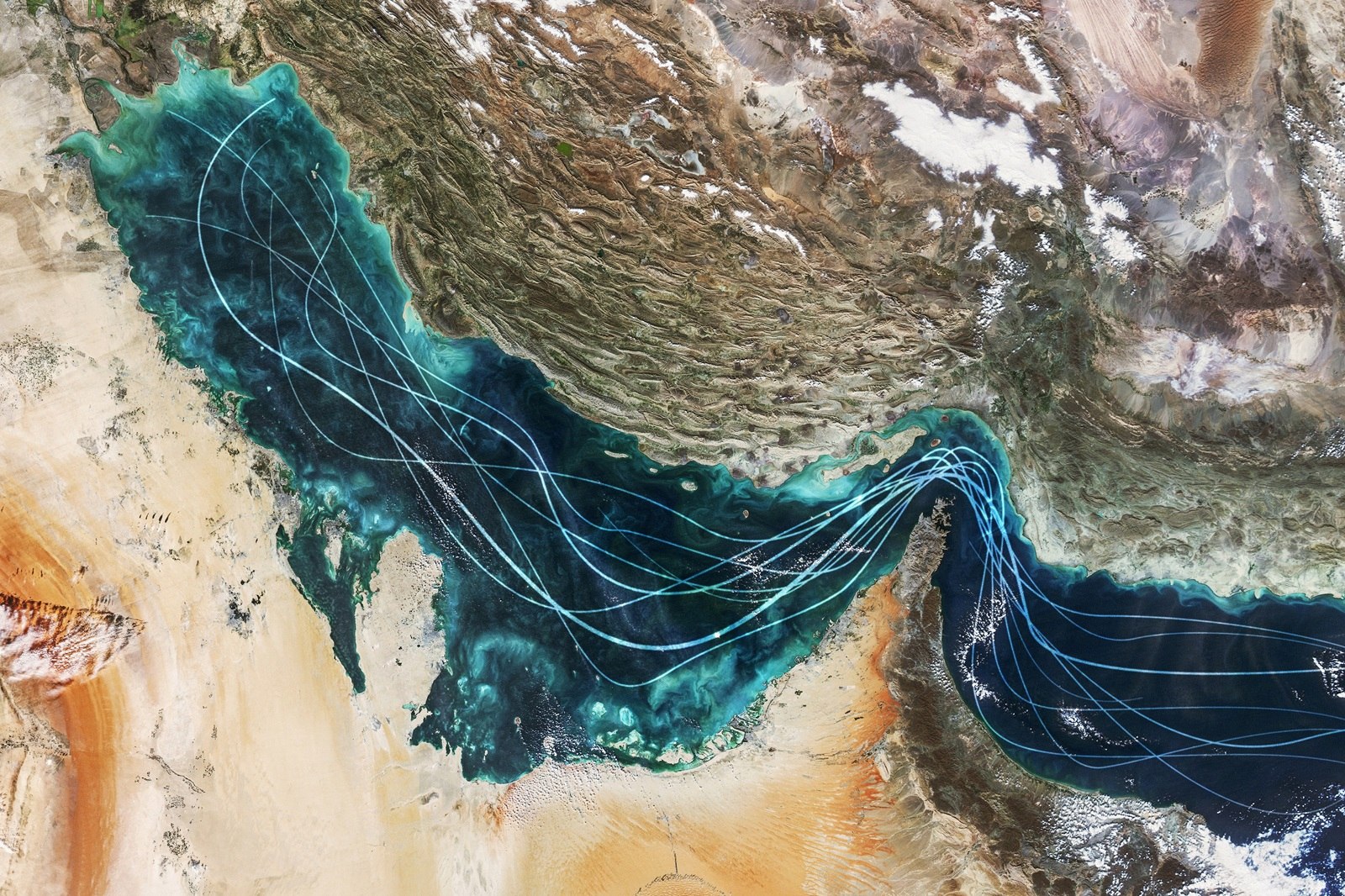
Whenever tensions rise in the Strait of Hormuz, attention turns to restoring normal shipping routes, protecting tankers, and preventing energy prices from surging. This is understandable, but it remains insufficient. Reopening the strait addresses the crisis only after it has occurred; the more fundamental challenge is to establish a system that makes closure more difficult in the first place.
Recent developments have shown that freedom of navigation remains governed more by balances of power than by effective institutions. When confrontation with Iran escalates, commercial vessels, energy tankers, and Gulf ports are quickly drawn into the conflict, even when they are not parties to it. A vital international waterway is thus transformed into a bargaining chip and an instrument of pressure.
The paradox is that the Gulf states, which depend most heavily on the strait and suffer most from its disruption, remain outside any permanent collective structure for decision-making concerning it. Geography, by contrast, gives Iran considerable practical capacity to influence navigation, and Tehran periodically seeks to translate that capacity into a political role extending beyond the legitimate rights of a littoral state.
The region must therefore move from crisis management to risk management. This paper proposes a regional charter for navigation and maritime security that would not exclude Iran, but would prevent it—or any other state—from unilaterally determining the conditions of passage. The core principle is straightforward: sovereignty over territorial waters must remain intact, but the international right of transit is non-negotiable.
First: What Is Wrong with the Existing System?
1. Legal Rules Without a Political Guarantee
The Strait of Hormuz does not operate in a legal vacuum. The international legal regime governing straits recognizes the right of transit passage and obliges littoral states not to impede or suspend it, while preserving their authority over navigational safety and pollution prevention. The International Maritime Organization has likewise affirmed that passage must remain unobstructed and non-discriminatory and that no fee may be imposed on transit itself.
The problem is that legal rules cannot enforce themselves. In the absence of a regional institution capable of verifying violations, assigning responsibility, and coordinating a response, enforcement remains dependent on power and on the willingness of international actors to intervene. This explains the persistent gap between the clarity of the legal right and the fragility of its exercise in practice. Put simply, the right of passage exists, but the system needed to protect it does not.
2. From Geographic Responsibility to Claims of Authority
Shipping lanes pass through the territorial waters of Iran and Oman. This gives both states direct responsibilities for navigational safety, rescue operations, and pollution control. It does not give them political ownership of the passage or the right to decide who may transit, when, or at what price.
The principal danger is not financial but political. The first fee accepted today, or the first communication requirement imposed unilaterally, could become tomorrow’s basis for an Iranian claim to an acquired right to manage the strait. Tehran has already proposed arrangements involving a broader Iranian-Omani role and the imposition of transit fees, moving beyond safety regulation toward an attempt to determine the conditions of passage.
Ambiguity should therefore not be treated as a convenient solution. What appears to be a temporary settlement during a crisis may become a permanent precedent once the crisis ends.
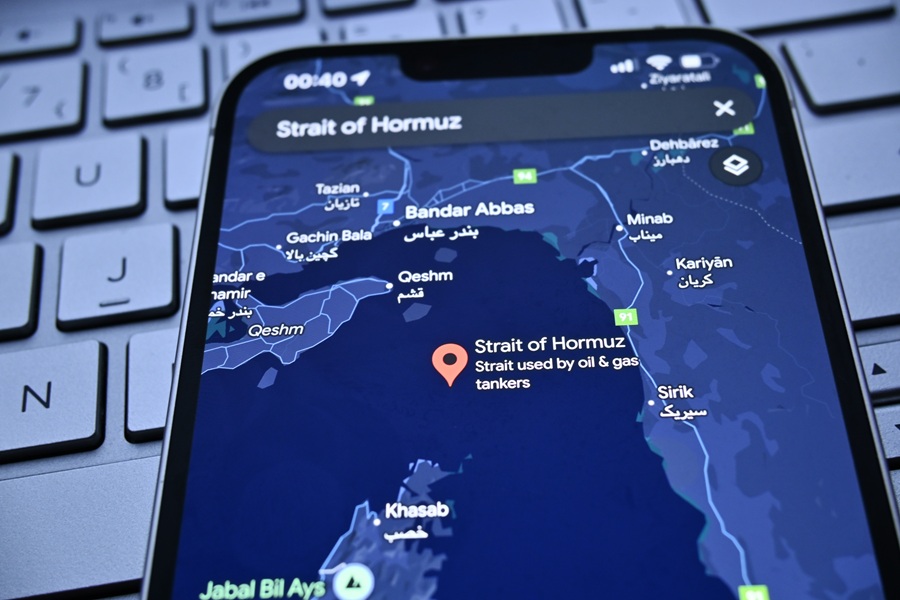
3. Iran’s Counterproposal: An Attempt to Rewrite the Rules of Navigation
Iran’s counterproposal to the Omani initiative showed that the dispute over the Strait of Hormuz is no longer limited to the question of how shipping should resume after the crisis. It now concerns who has the authority to redefine the navigational regime itself.
Instead of returning to the internationally recognized traffic separation scheme, Iran proposed a temporary arrangement under which all vessels entering the Gulf, along with some vessels leaving it, would pass through Iranian waters. Tehran also rejected Oman’s proposal for a more balanced distribution of routes, arguing that Iranian national security requires greater control over maritime traffic.
Iran did not present this proposal as a limited technical adjustment. It announced that it no longer recognized the traffic separation scheme approved by the International Maritime Organization in 1968 and rejected the participation of any third party in demining or securing the strait, even if such participation were requested by Oman. It also linked the reopening of the passage to acceptance of its new proposal.
These conditions show that Iran seeks not only a larger role in maritime safety; it is seeking to convert the outcome of the crisis into broader operational and political authority over the strait. Routing all inbound vessels through Iranian waters would give Tehran greater capacity to monitor commercial traffic, gather information, conduct selective interdictions, and impose additional conditions in the future.
The danger lies not in adjusting a shipping lane as such, but in the precedent such an adjustment could create. If the internationally recognized system is changed under the pressure of continued closure, a highly dangerous principle would take hold: that the use of force can rewrite the rules of international navigation, and that the state disrupting a passage can be rewarded with greater influence over its management.
Any transitional settlement must therefore neither grant Iran new operational authority over vessel movements nor accept the cancellation or modification of the traffic separation scheme outside the framework of the International Maritime Organization and without clear regional and international consent.
4. Major Gulf Interests, Limited Institutional Presence
The technical organization of shipping routes has historically been associated with Iran and Oman, which jointly proposed the traffic separation scheme adopted by the International Maritime Organization in 1968. However, regulating the direction of vessel traffic is not the same as determining the strait’s political and security order.
The United Arab Emirates, Saudi Arabia, Qatar, Kuwait, Bahrain, and Iraq all bear, to varying degrees, the costs of any disruption in Hormuz. It is therefore insufficient to consult these states only after core arrangements have been negotiated between Tehran and Muscat. They must be partners in designing the system from the outset, rather than merely being recipients of its consequences.
Second: What Alternatives Are Available?
1. Unilateral Iranian Management
Unilateral Iranian management is no longer a theoretical possibility. Tehran has advanced a concrete plan that would reroute all vessels entering the Gulf through Iranian waters, reject the existing traffic separation scheme, and exclude third parties from securing the strait. This transforms Iranian control from a potential risk into a declared project.
Such an arrangement would also open the door to using the strait as leverage in disputes unrelated to navigation, including sanctions, the nuclear program, and the conflict with the United States. Most dangerously, it could establish a precedent with implications for other international straits. The International Maritime Organization has warned that imposing fees or discriminatory conditions on passage has no legal basis.
2. Bilateral Iranian-Omani Management
This option has a clear advantage: it draws on Oman’s geographic position and balanced diplomatic role and could facilitate rapid de-escalation. Politically, however, it remains too narrow. It risks evolving into a bilateral division of authority over the strait, leaving the other Gulf states at the margins of decisions that directly affect their security and economic interests.
The solution is not to diminish Oman’s role, but to elevate it. Muscat could move from serving primarily as a mediator between Iran and other parties to hosting a broader regional institution.
3. Permanent Military Internationalization
An international naval presence may become necessary when mines are laid or vessels are attacked or seized. It is not, however, a suitable permanent framework for managing the strait. It would deepen militarization, increase the risk of confrontation, and leave commercial navigation dependent on the balance of power among major states.
Military force may reopen the passage, but it cannot by itself prevent repeated closures. Its role should therefore remain that of a backstop: enforcing the rules when they are violated rather than replacing the institutional framework needed to sustain them.
4. A Voluntary Regional Mechanism Based on the Malacca Model
Oman’s proposal, inspired by the experience of the Straits of Malacca and Singapore, is the most promising of the available options. It shifts the debate from control to cooperation and would allow navigational services, rescue operations, and environmental protection to be financed through voluntary contributions.
Hormuz, however, is not Malacca. Its security environment is more confrontational, and Iran views the strait as an instrument of influence. The proposed technical mechanism therefore requires a clear political and legal framework specifying what littoral states may and may not do. Without such a framework, a cooperative formula could become a more acceptable means of entrenching an old imbalance rather than correcting it.
Third: The Hormuz Charter for Navigation and Maritime Security
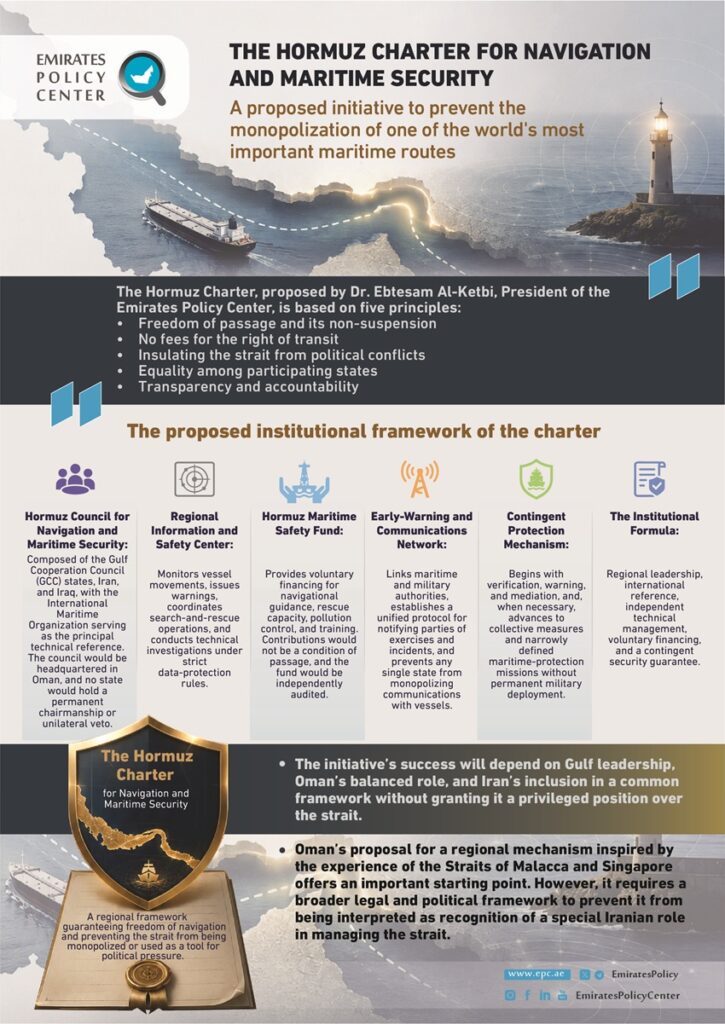
The proposed alternative is a multilateral regional charter supported by the International Maritime Organization. The charter would not divide control among states; rather, it would reject the premise that any state possesses a right of control in the first place.
It would distinguish among three issues that have long been conflated: sovereignty over territorial waters, the technical management of navigation, and the protection of the international right of passage. Sovereignty would remain with the littoral states, joint institutions would manage services and safety, and transit would remain a right that is not contingent on political approval or payment.
The Charter’s Five Principles
1. Freedom of passage and its non-suspension: Transit passage is a right enjoyed by all vessels and must not be subject to prior political authorization or discrimination based on flag, ownership, or destination. No state may unilaterally impose an alternative route or require vessels to communicate exclusively with a national military authority.
2. No fees on the right of transit: Rescue services, navigational guidance, and pollution control may be financed through voluntary contributions. However, payment must not be made a condition of passage, nor may payments be made directly to a littoral state in exchange for permission to transit.
3. Insulating the strait from political conflicts: The seizure or attack of vessels, the laying of mines, and the disruption of navigational systems must be prohibited as instruments of pressure in disputes unrelated to navigation.
4. Equality among participating states: Iran would participate as a littoral state, but without a permanent chairmanship, unilateral veto, or exceptional powers. Geography confers responsibility, not superior status.
5. Transparency and accountability: Incidents would be subject to independent technical investigation; essential findings would be published; and responsibility would be determined on the basis of reliable evidence rather than competing political narratives.
Fourth: How Would the Charter’s Institutions Operate?
1. Hormuz Council for Navigation and Maritime Security
The council would establish general policy, coordinate emergency responses, approve environmental protection programs, oversee the regional center and fund, and review complaints and alleged violations. Oman would be the preferred location for its headquarters. This would not grant Muscat any special authority over the strait, but would draw on Oman’s geographic position and balanced relations. Technical decisions would be adopted by majority vote, provided they neither infringe the right of passage nor conflict with International Maritime Organization rules.
2. Regional Information and Safety Center
The center would serve as the charter’s operational arm. Its primary task would be to maintain a common and reliable picture of maritime traffic and prevent any single state from monopolizing information. It would issue alerts, coordinate search-and-rescue operations, monitor environmental risks, investigate incidents, and publish periodic reports. It would not replace national authorities; instead, it would connect them through a unified network and provide shipping companies with a neutral point of reference.
3. Hormuz Maritime Safety Fund
The fund would be financed through voluntary contributions from regional states, energy-importing countries, and shipping, energy, and insurance companies. It would support navigational guidance, search-and-rescue capabilities, pollution control, training, and technological development. The distinction between voluntary financing and payment for passage is critical. Contributions must never become the price of non-disruption. Vessels would therefore make no payment to a littoral state in exchange for permission to pass, and contributors would receive no preferential treatment.
4. Early-Warning and Communications Network
The network would establish hotlines among maritime and military authorities, rules for notifying parties of exercises, tests, and incidents, and direct communication channels between the regional center and transiting vessels. These arrangements are not merely procedural. In an area crowded with military forces and commercial shipping, rapid and reliable communication may make the difference between a limited incident and a wider escalation.
5. Contingent Protection Mechanism
The charter would establish clear consequences for violations. The response would begin with technical verification, followed by an official warning and mediation, and, if necessary, political and economic measures. If aggression continued, a multinational maritime-protection mission could be activated to carry out narrowly defined tasks, such as mine clearance and vessel escort. This mechanism would not place the strait under foreign management. It would make force a means of defending an agreed rule, not a substitute for a regional order.
Fifth: A Realistic Path to Implementation
Phase One — Establishing a common Gulf position: The GCC states would agree on a set of principles that leave no room for ambiguity: no fees on the right of passage, no arrangements imposed unilaterally, and no bilateral negotiations determining the future of the strait without full Gulf participation.
Phase Two — Forming a political and technical working group: The group would draft the charter, define the mandates of its institutions, and examine relevant international models in early coordination with the International Maritime Organization.
Phase Three — Launching regional dialogue with Iran and Iraq: Dialogue would begin with practical issues, including search and rescue, pollution control, collision prevention, and the exchange of warnings. Cooperation in these areas would not eliminate political disagreements, but it would test the parties’ willingness to operate within agreed rules.
Phase Four — Establishing transitional arrangements: The regional center and fund could be established before the charter is finalized, provided that they do not become a cover for unilateral or bilateral arrangements.
Phase Five — Adopting the charter and securing international guarantees: Once regional consensus is reached, the charter would be submitted to the International Maritime Organization and the states that use the strait for their endorsement. Leadership would remain regional, while international legitimacy would provide technical and legal backing.
Sixth: Obstacles That Must Not Be Underestimated
1. Iran may accept technical cooperation while rejecting political constraints: Tehran may welcome cooperation on navigational safety and environmental protection while opposing any framework that limits its ability to use the strait as leverage. The charter must therefore combine clear incentives for cooperation with clear political costs for unilateral action.
2. Divergent Gulf calculations: The Gulf states do not depend on the strait to the same extent, nor do they share identical views regarding relations with Iran or the role of an international military presence. Continued reliance on separate arrangements, however, would make the Gulf position more vulnerable to fragmentation.
3. Voluntary financing could become a de facto fee: What begins as a voluntary contribution may gradually evolve into a practical obligation. The remedy is to maintain a strict separation between the fund and the right of transit, while prohibiting direct financial dealings between vessels and littoral states.
4. Politicization of data: The proposed Regional Information and Safety Center will fail if companies or states suspect that its data are being used for intelligence purposes. Professional governance and information protection are therefore essential conditions of trust.
5. Absence of enforcement: Principles alone will not deter attacks or other serious violations. Graduated responses must be agreed upon in advance so that each incident does not trigger a new round of bargaining only after a crisis has already erupted.
What Should the GCC States Do?
- Adopt a unified position rejecting unilateral management of the strait and the imposition of fees on the right of transit.
- Prepare a Gulf draft of the charter rather than merely respond to Iranian or international proposals.
- Support and expand the Omani initiative while preserving Gulf leadership and maintaining international legal reference.
- Distinguish between urgent arrangements required to restore navigation and the permanent regime governing the strait, so that concessions made during a crisis do not become rules for the future.
- Develop joint capabilities in search and rescue, mine clearance, maritime surveillance, and infrastructure protection.
Conclusion
The Strait of Hormuz does not need a new guardian. Replacing Iranian control with permanent foreign military management would not address the underlying problem; it would merely transfer authority from one actor to another. The most realistic solution is a regional system in which all relevant states participate but none enjoys a privileged right—a system that safeguards Iran’s legitimate interests in navigational safety and environmental protection, gives Oman a central role, enables the Gulf states to participate in rule-making, and retains an international guarantee when needed.
The required formula is clear: Iranian participation without guardianship; regional responsibility without monopoly; contributions to services without fees on transit; and an international guarantee without permanent internationalization.
The question is no longer how to reopen Hormuz after every confrontation, but how to ensure that it cannot be closed again. That is the essence of the proposed charter: a strait that belongs to no single state, that no state may close, and that all participating states share responsibility for protecting.